
If you’ve heard of the peregrine falcon (Falco peregrinus), you’ve also heard of their incredible style of flight that has earned them the title of the fastest animal on Earth. In 2005, National Geographic filmed Washington falconer Ken Franklin’s peregrine, named Frightful, stooping at 242 mph! Frightful’s record-breaking flight blew all previous expectations of a peregrine falcon’s top speed (estimated to be around 200 mph) out of the water. Not just any bird can match the speed of a peregrine in full stoop, so what makes the peregrine falcon so different?
The Importance of Body Shape
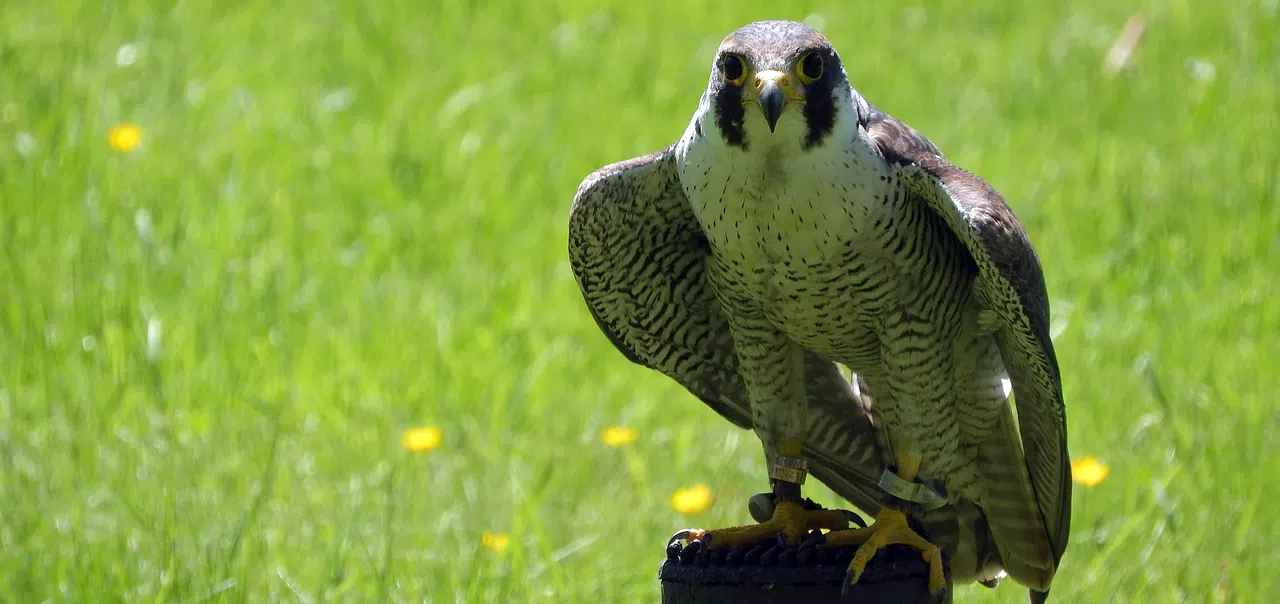
Arguably the most important adaptation of a peregrine falcon is body shape. Peregrine falcons belong to the order Falconiformes, a group that currently contains around 65 known species of falcon. Even among these many other falconiforms, peregrines are by far the fastest species. The reason for this is a host of adaptations that make their bodies uniquely aerodynamic. A peregrine’s body feathers are sleek and keep a smooth form in flight, which produces a contiguous shape that ‘slices’ through the air with little resistance. Peregrine falcons also lack the bony brow ridge seen in other raptors, such as hawks. At such high speeds, even this adaptation that may seem relatively minor reduces drag and air resistance.
Wing Anatomy
The most dramatic adaptations are seen in a peregrine falcon’s wings. Viewed in flight, the wings of a peregrine are notably long and come to a thin taper. This feature makes falcons stand out so much in flight that falconers even refer to birds belonging to this group as “longwings.” The feathers covering the leading edge of the wing– also known as coverts– are similar to the body feathers. They are densely-packed and keep smooth to the wing in flight to reduce drag. This thicker part of the wing smoothly tapers into the thinner trailing edge of the wing, which is reinforced by rigid primary feathers. At the highest point of the dive, a peregrine falcon tucks its wings close to its body. This tapered, trailing shape of the wings gives the bird a ‘teardrop’ shape when viewed from the side in full stoop, which dramatically reduces air resistance.
Air Intake Systems
If most birds attempted the dive of a peregrine falcon, their respiratory systems would not be able to manage the rapid, direct intake of air into the lungs, nor would they be able to breathe during the descent. To cope with the immense air pressure of a dive, peregrine falcons have evolved a complex internal nasal structure called a tubercle. Upon looking at a falcon, you may notice a small, spikelike structure protruding from the inside of their nostrils. You’re looking at the cone-shaped external part of the tubercle, which helps diffuse air as it is forced into the nostrils. From there, the air is pushed into a set of bony, spiraling chambers within the falcon’s nostrils before it ever enters the lungs. This forces it to slow down before it enters the lungs, so the sudden, direct air intake doesn’t damage the bird’s respiratory system.
Inspiration in Mechanical Engineering
The speed of a peregrine falcon is a marvel of the natural world. Naturally, we have looked to the incredible adaptations of these birds as inspiration for the design and engineering of cars, airplanes, rockets, and other mechanical systems. The field of aviation engineering in particular has been revolutionized by some of the designs inspired by peregrine falcons. For example, the teardrop-shaped body of a peregrine in full stoop and their sickle-shaped wings are what inspired the shape of the B-2 stealth bomber. Similarly, you may notice that some jet engines have a familiar protruding ‘spike’ like what is found in the nostrils of falcons. This is because engineers have mimicked the shape of the nose tubercles found in peregrine falcons to act as a baffle for the air intakes of jet engines. Jet engines that have no way to baffle air intake can run into a similar problem faced by many birds: they can “choke” and stutter when air enters engines too forcefully. By looking to these incredible animals as sources of inspiration, engineers have not only designed aircraft to be faster and more efficient, but far safer.
Want to learn more about Peregrine Falcons?
Check out our falconry experiences over on our other website https://www.hawkeyefalconryschool.com