
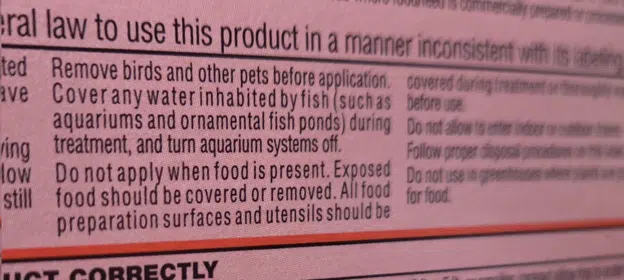
No part of the ecosystem can operate independently without some sort of tie to the living and nonliving things around it. This includes everything humans introduce to the environment. Despite certain actions having specific outcomes in mind, there will always be a side effect and/or another stakeholder that may never be acknowledged. In some cases, the cascades of effects are so drastic that they need to be addressed and corrected.
Such is our understanding of pesticide application. We lose control of the chemical when we use it - whatever happens next is a choice of nature. Unfortunately, nature has plans that we do not, and there are consequences we can’t predict. Birds, mobile and fragile as they are, are great models of this dynamic.
This article does not talk about pesticide biochemistry. If you are interested in that topic, navigate to Part One to learn more.
 How Pesticides Travel
Because they cannot move on their own, chemicals rely on the properties of the stuff around them to reach their destination. Think about putting a drop of food coloring into a cup of water, then pouring the colored water into a bucket of more water. You can see the colored fluid make its way around the volume, even if you don’t mix it, because the molecules of the food coloring are attracted to the charge of the untouched water.
Pesticides are no exception. Based on their components, they may be drawn to water, fats, or other charged molecules. This makes them unfortunately “sticky”, where a brush of a leaf, a small gust of wind, or the path of a raindrop can draw them away from where they’re supposed to be working.
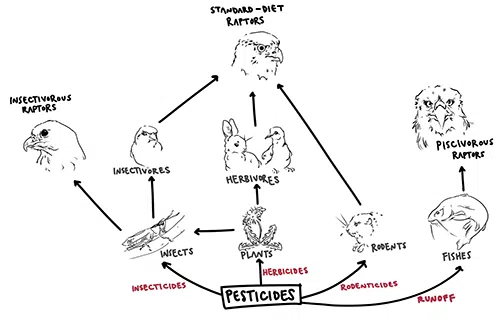
Pesticides can make their way into a raptor’s body in a lot of ways, even if they aren’t eating or drinking contaminated things. Breathing them in, having them dissolve through their skin, and preening it off their feathers are some examples. As more pesticides make their way up the food chain, more of them may be seen per capita in predators than in their target. This is what is known as biomagnification.
How Birds Suffer
The metabolism of a bird is a lot different than the metabolism of a mammal or insect. In general, they eat more, move faster and farther, and have different digestive enzymes.
Because there are so many kinds of birds with so many kinds of lifestyles, the health of the birds in an ecosystem is reflective of the health of the ecosystem itself. The ways pesticide exposure interferes with raptor reproduction helped bring their toxicity to the public eye, specifically in the case of the peregrine falcon.
Walking on Eggshells
Observations of thinning eggshells in predatory birds began in the early 1900s. It coincided with the use of DDT as an insecticide, originally for controlling the spread of typhus and malaria in World War II. As its effectiveness in this endeavor became more and more evident, the popularity of the pesticide grew worldwide for mosquito control, becoming available for farmers in 1945.
Accirding to. D.A. Ratcliffe, peregrine falcons that nested in British eyries had an abnormal amount of broken eggs in 1958. This, alongside lifted protections spurred by the discontent of pigeon fanciers, led to an enormous decline in British peregrine populations. The trend was mirrored in the United States as the bioaccumulation of DDT tore through falcon populations, leading to the declaration of the peregrine as endangered in 1970 and 1973. The tandem decline in bald eagles, osprey, brown pelicans, and songbirds led to the ban of DDT in 1972.
Captive breeding programs like that of The Peregrine Fund aided in the reintroduction of newly imperiled species after the ban. Persistence of DDT in the environment does continue to pose a threat, but the birds we know and love are not in as dire of a situation as they were previously. For example, peregrine eggs in Sweden saw a near 30 percent thickness decrease during the crisis, but are now only 7 percent thinner than historical samples, according to Knud Falk in 2024.
Why Did Pesticides Decimate the Raptor Populations?
To understand what was happening to our raptors, we had to look to smaller species that lay more eggs in less time. In 1970, Peakall saw less estradiol in doves of the genus Streptopelia, which is a hormone that drives the selection of mates and the formation of the egg, including the shell. DDT also inhibited the enzymes carbonic anhydrase and calcium ATPase that provide calcium for the eggshell. This was also noted by Bitman et al in Japanese quail in the same year.
Japanese quail were also examined by Kamata et al in 2019, where development of the ovary was wholly affected by direct introduction of DDT to the reproductive tract. The left oviduct developed poorly with lower quantities of calcium-binding proteins that aid in eggshell production. The right reproductive tract, which normally does not develop, actually grew to an immature level when DDT was present!
Some birds do not get the opportunity to reproduce after pesticide exposure, and some birds are more sensitive than others. Pesticide exposure generally causes neurological symptoms that are often life threatening. If affected birds are hunted by raptors due to their weakness, bioaccumulation can easily take place.
 Our Responsibility
Pesticides are not evil. Even DDT was not originally put into circulation with its bird-related consequences in mind. The public use was intended to relieve the pressures of malaria and other illnesses on people at risk. The tumultuous relationship between pesticides and birds prove that we, as humans, hold great power over the functions of our planet, and we are responsible for risk assessment.
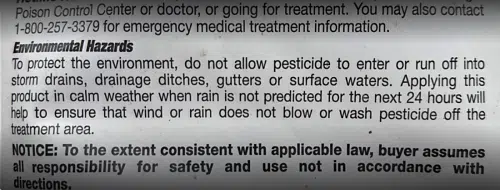
If you are inclined to use a pesticide or herbicide, take some time to educate yourself on its potentially harmful effects to the stuff you’re not targeting. Use it only as the packaging directs, or hire a professional to do it for you. You can also seek out alternative pest control measures, like diatomaceous earth or essential oils.
Contact Hawkeye Bird & Animal Control
To learn more about alternatives to pesticides and more environmentally friendly bird control, contact the bird abatement experts at Hawkeye.
Contributing writer and researcher: Logan Bourgeois
Related Articles:
https://www.falconryusa.com/blog/pesticides-part-1-types-and-toxins